10 Best The $2 Neighborhoods
The United States two-dollar bill, often regarded as a curious anomaly amidst the more commonly circulated denominations, holds a unique place in American currency history and popular culture. Unlike its ubiquitous peers, the $2 bill has traversed a journey marked by intermittent production, distinct imagery, and a blend of mystique and practicality that invites both fascination and misunderstanding. Within this exploration, the multifaceted nature of the $2 bill will be unveiled, from its historical evolution and design intricacies to its cultural impact and potential as a collectible asset. This examination reveals unexpected layers behind a currency note that often evokes a double take.
The Historical Evolution of the $2 Bill
The $2 bill, emblazoned with the visage of Thomas Jefferson, traces its inception to the dawn of the United States currency system. Introduced in 1862 during the tumultuous years of the Civil War, the denomination was part of the government’s effort to standardize and expand the money supply. Unlike denominations such as the $1 or $5 bill, the $2 bill endured various design phases and intermittent production halts, making it somewhat of an ephemeral actor on the monetary stage. Over the decades, fluctuations in demand and shifts in issuance policies led to the bill’s sporadic presence in circulation. Notably, the 1976 redesign commemorated the United States Bicentennial by replacing the traditional image on the reverse with a reproduction of John Trumbull’s iconic painting, “The Declaration of Independence,” an artistic pivot that emphasized the bill’s symbolic stature.
Design Elements and Symbolism Embedded Within the $2 Bill
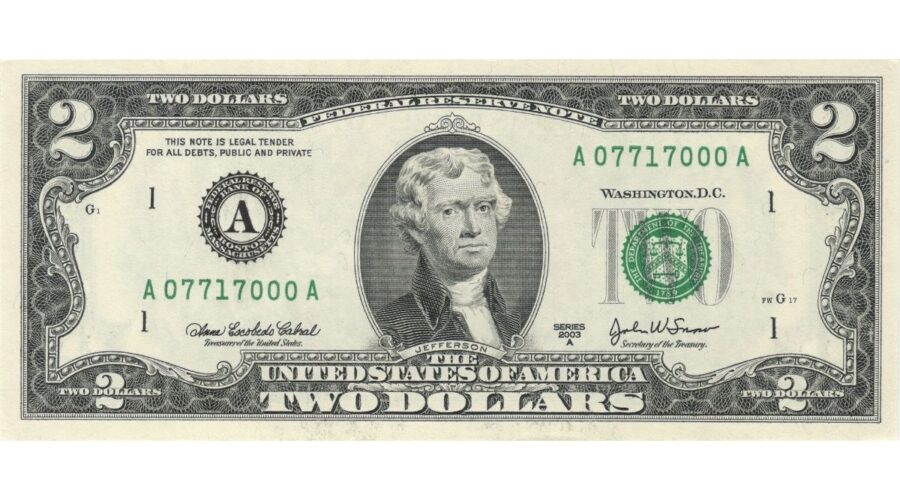
The appearance of the $2 bill is rife with iconographic elements that reflect the heritage and identity of the nation. The obverse side proudly carries the portrait of Thomas Jefferson, the third President of the United States and principal author of the Declaration of Independence, reinforcing themes of liberty and democratic principles. The reverse showcases the stirring scene from Trumbull’s painting, capturing the momentous occasion of America’s founding—a motif absent from other denominations. Additional intricacies include fine line engraving, microprinting, and precise use of green and black inks, offering visual security while promoting aesthetic appeal. These artistic choices underscore the convergence of function and symbolism, creating a currency note that is as much a work of art as a financial tool.
The $2 Bill in Circulation: Myths and Realities
Despite its legitimacy as legal tender, the $2 bill suffers from widespread misconceptions. Many hold the erroneous belief that it is no longer in production or that it carries special, perhaps even mystical, powers. In reality, the Federal Reserve continues to print $2 bills in limited quantities, although their use in daily commerce is rare. This scarcity has contributed to the bill’s aura of rarity, prompting some to hoard rather than spend it. Mythology around the $2 bill includes notions of it being lucky or unlucky, depending on regional folklore, and even tales of it being used in secret transactions. However, from a practical standpoint, the $2 bill functions identically to any other denomination, accepted wherever U.S. currency is honored. The disparity between perception and reality has cemented the $2 bill’s status as an American curiosity.
Collectibility and Investment: When Currency Becomes Valued Beyond Face Value
Beyond its role as a medium of exchange, the $2 bill has garnered attention among numismatists and collectors. Certain series, printing errors, and uncirculated notes can command premiums well above their face value. Bills from distinctive years or those bearing unique serial numbers become coveted artifacts, surfacing in auctions and private sales. The condition of the bill—graded meticulously by experts—further influences its desirability. For instance, bills from early series or those in pristine, “uncirculated” condition gain a niche status, often fetching prices that reflect their rarity and historical significance. Collectors seeking these notes often rely on catalogs and price guides, evaluating factors such as printing dates, ink variations, and plate positions. In this context, the $2 bill transcends currency, entering the realm of tangible history and speculative asset.
Cultural and Social Implications of the $2 Bill
Throughout the years, the $2 bill has sparked a variety of cultural expressions. Its relative scarcity has made it a novelty gift item, a prop in magic and entertainment acts, and a symbol in political and social commentary. Some businesses encourage payments in $2 bills as a marketing gimmick or to highlight American heritage. Additionally, it appears in folk tales and anecdotal narratives where it signifies good fortune or peculiarity. The bill often plays a role in educational contexts, sparking discussions on currency design, economics, and history. Its unique status has also led to its appearance in cinema and literature, where it serves as a plot device or emblem of Americana. In essence, the $2 bill occupies a symbolic niche that transcends its monetary function, embodying aspects of Americana that resonate deeply within the cultural psyche.
Future Prospects: The $2 Bill in a Modern Economy
In an era increasingly defined by digital transactions and the gradual decline of physical currency usage, the $2 bill faces an uncertain future. Innovations in electronic payments, contactless cards, and cryptocurrencies challenge the relevance of paper money altogether. Nevertheless, the $2 bill maintains its foothold, albeit small, within the tangible cash ecosystem. Its continued printing, though limited, signals institutional commitment to preserving traditional denominations. Moreover, as the public’s appetite for historical and collectible currency prevails, the $2 bill likely will retain a dual role—as a functioning currency and a cherished relic. Financial institutions and the public at large remain divided on whether the $2 bill will experience resurgence or eventual obsolescence. However, its storied past and enduring symbolism provide a solid foundation for ongoing interest in its fate.
How to Identify and Authenticate $2 Bills
For those curious about collecting or simply recognizing authentic $2 bills, certain features are paramount. The paper used is a distinctive cotton-linen blend adorned with embedded security fibers visible under close examination. Printing techniques include intaglio engraving, which creates textured, raised ink surfaces noticeable by touch. Serial numbers in unique fonts and color schemes assist in identification, as does the presence of Federal Reserve and Treasury seals, each with specific placement and characteristics. Counterfeit prevention has evolved, incorporating microprinting and security threads in other denominations, though the $2 bill’s lower circulation limits extensive anti-counterfeit features. Understanding these attributes not only enriches one’s appreciation but also guards against fraudulent imitations, especially in the collector’s market.
Practical Uses and Tips for Circulating the $2 Bill
While the $2 bill is often regarded as a collector’s item, it nonetheless functions as legal tender fully usable in everyday transactions. Many people find using $2 bills a novel way to tip, make change, or add character to cash exchanges. Businesses that accept and circulate $2 bills help maintain their visibility and utility. For consumers, requesting $2 bills from banks or during transactions can invigorate the local cash flow of this curious denomination. It also serves as a conversation starter or a memorable token, distinguishing payments and gifts from the mundane. Successfully integrating $2 bills into daily commerce not only preserves their relevance but also enhances awareness and appreciation of this unique piece of American currency.